
Dr. Alexander Asmah: Rewriting the DNA of African Rural Banking
Africa’s 10 Most Impactful Business Leaders to Watch in 2026
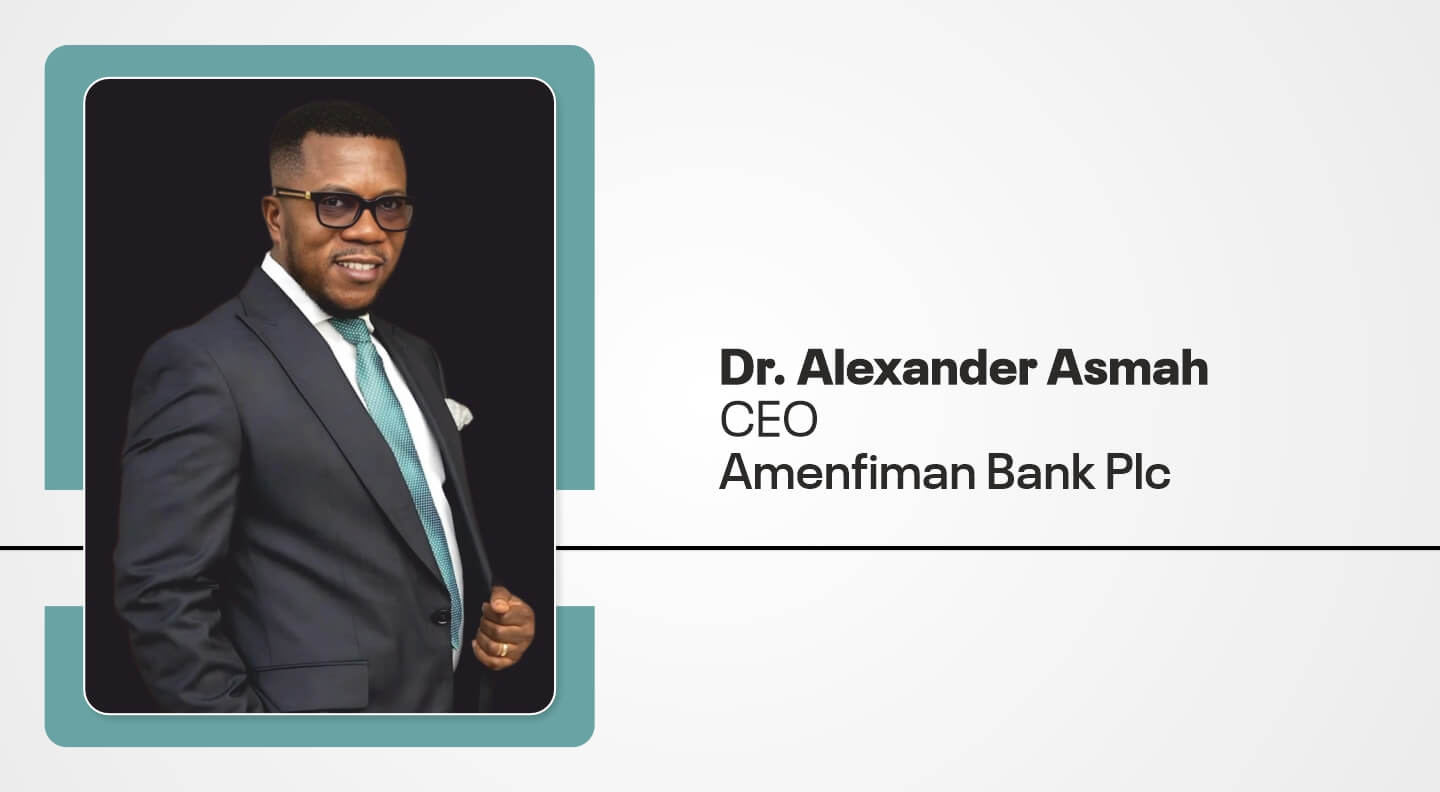
The red dust of the Western Region settles differently than the concrete dust of Accra. Out here, the economy does not hum to the rhythm of stock tickers or high-frequency trading algorithms; it pulses with the harvest of cocoa, the turning of agro-processing machinery, and the relentless daily grind of the informal sector. For decades, traditional commercial banking looked at this landscape and saw only risk. One person saw uncollateralized labor. They saw a void.
Dr. Alexander Asmah looked at the exact same landscape and saw an ecosystem waiting to be industrialized.
As the CEO of Amenfiman Bank Plc, Dr. Asmah has orchestrated one of the most quiet yet seismic financial revolutions on the African continent. Under his stewardship, the institution has shattered the invisible ceiling that historically confined rural banks to micro-status. Becoming the number one rural bank in Ghana was a headline that captivated the national press, but for Dr. Asmah, it was merely the prologue.
“Becoming the number one rural bank in Ghana was never the destination,” Dr. Asmah notes, his voice carrying the quiet, absolute certainty of a leader who has already mapped out the next decade. “It was proof of concept. My North Star now is institutional immortality.”
In the high-stakes world of African finance, where economic volatility can erode decades of progress in a single fiscal quarter, aiming for “immortality” sounds audacious. But Dr. Asmah has the ledger to back up his ambition. Over fourteen years, he has engineered an exponential transformation: driving asset growth from a modest GH₵18.8 million to a staggering GH₵2.8 billion, and swelling deposits from GH₵15.3 million to GH₵2.3 billion.
Yet, when examining his vision for 2026 and beyond, the CEO is decidedly uninterested in resting on the laurels of asset multiplication. Growth, he insists, is just math. Permanence is an art.
The Harvard Mind in a Ghanaian Market
To understand the Amenfiman Model, one must first understand the intellectual architecture of its chief architect. Armed with a Doctorate in Business Administration (DBA) specializing in Global Business and Leadership, Dr. Asmah presents a fascinating dichotomy. He is a scholar who has walked the hallowed halls of Harvard and IESE, absorbing the high-altitude global strategy programs of advanced markets. Yet, he is fundamentally an “implementation leader,” a CEO who is just as comfortable sitting on a wooden bench at a local SME forum as he is in a corporate boardroom.
This academic background fundamentally altered his perspective on community banking. Historically, rural banks in emerging markets have operated on a transactional binary: you are either a depositor or a borrower. Dr. Asmah dismantled this model.
“I treat them as economic ecosystems,” he explains. “Global leadership studies taught me that sustainable growth happens when capital, capacity, and culture align.”
When Dr. Asmah looked at the informal and semi-formal sectors of Ghana, he didn’t try to force-feed them Wall Street frameworks. Instead, he contextualized global principles for local realities. The Amenfiman MSME model evolved to encompass not just financing, but intensive business advisory support, capacity-building workshops, and market linkage facilitation. The bank ceased to be a mere lender and transformed into a mentor.
Despite his academic pedigree and executive title, Dr. Asmah refuses to lead from an ivory tower. He intimately understands that proximity is a rural bank’s greatest competitive advantage – a moat that large commercial banks, hampered by centralized bureaucracy in the capital, simply cannot cross. He still personally reviews operational reports, engages directly with junior staff, and makes unannounced branch visits.
“Leadership must remain grounded,” he asserts. “I sit in credit committee discussions. I visit client facilities. Strategy without execution is hallucination.”
Redefining Risk: The One-Million Cedi Handshake
Perhaps the most radical manifestation of Dr. Asmah’s philosophy is the bank’s recent overhaul of its lending parameters. In a climate where credit is notoriously tight, Amenfiman Bank upgraded its AMERB MSME Donkomi Plus product to a GH₵1 million collateral-free threshold.
To traditional bankers, offering a million cedis without hard assets to back it up sounds like a fast track to insolvency. But Dr. Asmah is quick to correct this misconception.
“Financial inclusion without discipline becomes financial destruction,” he warns. The decision was not a leap of faith; it was a calculated maneuver backed by over a decade of proprietary data. Amenfiman had spent years meticulously logging behavioral lending records, eventually building internal credit scoring models predicated on cash flow analytics rather than traditional collateral dependency.
Dr. Asmah’s risk management strategy is a masterclass in structural discipline. It relies on a balanced matrix: strict sector-based risk caps, continuous behavioral repayment tracking, and mandatory financial literacy participation for clients. He also enforces rigorous portfolio diversification across industries and maintains a notoriously strong internal audit culture.
“The key insight is this,” Dr. Asmah states, delivering what could easily be the thesis of his banking career. “Risk is not eliminated by collateral; it is mitigated by information. Loans are not paid by collateral; disciplined relationship culture does. We know our clients intimately; we understand their businesses well.”
This data-driven, relationship-heavy approach is currently acting as a catalyst in the national SME Growth and Opportunity (GO) Programme. By channeling blended financing structures into the Western, Western North, Central, and Ashanti
regions, Amenfiman is providing the crucial growth capital that stands between a struggling local business and a regional powerhouse. Dr. Asmah is currently hunting for what he calls “local champions” – promising enterprises in manufacturing, agro-processing, hospitality, and logistics capable of employing 50 to 200 people within three years.
“This is how rural poverty reduces,” he notes. “Not by micro-loans alone, but by scaling mid-tier enterprises into regional anchors.”
Smart Economics: ESG as a Profit Driver
In global corporate circles, Environmental, Social, and Governance (ESG) mandates are often treated as a compliance checklist or a public relations exercise. In the rural trenches of Ghana, Dr. Asmah has weaponized ESG to directly impact the bank’s bottom line.
Under his directive, Amenfiman made a deliberate pivot to prioritize financing for environmentally sustainable agribusinesses, with a specific focus on cocoa value-addition and responsible mining supply chains. The results were instantaneous and quantifiable. By shifting the portfolio toward ESG-compliant operators, default rates plummeted. Insurance premiums dropped. Crucially, the bank’s forward-thinking stance acted as a magnet, drawing increased partnership interest from international development agencies.
But the “S” in ESG – Social impact – is where Dr. Asmah’s strategy truly shines, particularly regarding demographics. He recognized early on that Ghana’s economic resilience over the next five years hinges squarely on two pillars: youth entrepreneurship and women-led enterprises.
“Because demographics are destiny,” Dr. Asmah states simply. “Youth demonstrate innovation speed. Women demonstrate stronger repayment discipline.”
By targeting these demographics through structured SME programs and internal women leadership initiatives, Amenfiman is doing more than funding businesses; it is stabilizing entire communities. Dr. Asmah understands the multiplier effect of female financial empowerment, which historically translates directly into improved household health, education, and generational wealth.
This gender inclusion focus is mirrored internally. Amenfiman has earned prestigious recognition among top employers for gender equality. Far from being a vanity metric, this has massively strengthened talent retention, lowered staff turnover, improved productivity, and slashed recruitment costs.
“ESG is not a charity, it is smart economics.” Dr. Asmah says flatly.
Digital Spine, Human Heart
As the industry looks toward 2026, the specter of financial technology (fintech) looms large over traditional banking models. Mobile money and digital wallets have rapidly penetrated even the most remote African geographies. The question naturally arises: how does a “brick-and-mortar” rural bank survive this digital-first revolution?
“Fintech is not our competitor, irrelevance is.” Dr. Asmah fires back immediately.
Amenfiman is currently undergoing a massive technological evolution, aggressively digitizing customer onboarding, expanding mobile banking channels, and investing heavily in core banking upgrades. They are embracing data-driven personalization and expanding their agency banking networks.
Yet, Dr. Asmah adamantly refuses to eliminate the human element. While traditional banks are closing physical locations to cut costs, Amenfiman grew its footprint from 8 branches to 24 across four regions.
“In rural communities, trust is built physically,” he explains. His strategy is encapsulated in a four-word mantra: Digital Spine, Human Heart. The future of community banking, according to Dr. Asmah, is strictly hybrid. The technology must be world-class and frictionless, but there must always be a familiar, empathetic human being available for branch advisory services when a local farmer or shop owner needs guidance.
Shielding the Ecosystem
The global economic climate projected for 2026 is fraught with inflation concerns and currency volatility. For MSMEs operating on razor-thin margins, macroeconomic shocks can be fatal. Yet, a digital spine and a human heart are only as strong as the environment they inhabit. Recognizing that true institutional permanence requires more than just internal efficiency, Dr. Asmah has fortified the bank’s operational DNA with a proactive, three-layer shield designed to protect his clients from the tremors of a volatile global economy.
- Supply Chain Localization: The bank is aggressively encouraging local supply chain integration among its clients to reduce their vulnerability to import costs and foreign exchange fluctuations.
- Agile Credit Structuring: The bank is structuring shorter credit cycles for sectors identified as highly vulnerable to sudden economic shifts.
- Financial Education: Drawing on his own deep treasury discipline background, Dr. Asmah has spearheaded a push for treasury education, teaching SMEs sophisticated pricing strategies, how to maintain diversified liquidity buffers, and how to utilize forward supplier contracts.
It is a level of macroeconomic sheltering rarely afforded to rural enterprises, further cementing Amenfiman’s role as an economic anchor rather than a mere lender.
Succession, Education, and the Ultimate Legacy
For all the talk of growth, assets, and technology, the narrative inevitably circles back to Dr. Asmah’s original North Star: institutional immortality.
A company cannot outlive its founder without a meticulously cultivated pipeline of future leadership. To this end, Dr. Asmah established the Amenfiman Talent Academy. Here, the focus is not merely on technical banking skills, which Dr. Asmah notes can always be trained. The academy is designed to forge character, specifically seeking out integrity, accountability, and what Dr. Asmah views as the holy grail of leadership traits: an ownership mindset.
“I look for individuals who take initiative without waiting for instruction,” he says. “We groom leaders who think like shareholders, not employees. Success without succession is a failure. The future belongs to those who execute. And such are the next generation of leaders for Amenfiman.”
This commitment to education extends far beyond the bank’s walls. One of the most ambitious upcoming initiatives on Dr. Asmah’s docket is the establishment of the Amenfi State University College. Built in direct collaboration with local chiefs and the community, the institution will focus entirely on equipping the next generation with employable skills and entrepreneurial acumen. It is a physical manifestation of his belief that building capacity is just as vital as providing capital.
Navigating the immense pressure of his position is a solitary endeavor. He has been crowned with numerous accolades – Ghana’s Most Respected CEO, Africa’s Most Respected CEO, Financial Inclusion Champion – yet he waves the titles away.
“Awards are applause. Results are responsibility,” he notes, acknowledging the profound weight of carrying the payroll of hundreds of families and the sacred trust of thousands of local depositors.
In the next ten years, Dr. Asmah plans to export the “Amenfiman Model” across the continent. By sharing their five exportable pillars – community integration, MSME specialization, strong board governance, the internal talent academy pipeline, and disciplined asset growth – through advisory partnerships, he hopes to cure the weak governance that plagues many African rural banks.
“When this magazine is reviewed a decade from now,” Dr. Asmah says, looking far past the horizon, “I want it recorded that we professionalized rural banking. That we proved community finance can scale responsibly. That we bridged the wealth gap between urban and rural Ghana. And that we built leaders, not followers.”
If Amenfiman transitions into a national-tier institution while keeping its rural soul intact, Alexander Dr. Asmah won’t just leave behind a legacy of profitability. He will leave behind a blueprint for African economic liberation.