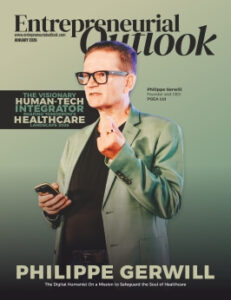
Philippe Grewill: The Digital Humanist On a Mission to Safeguard the Soul of Healthcare
The Visionary Human-Tech Integrator Shaping Tomorrow’s Healthcare Landscape 2026
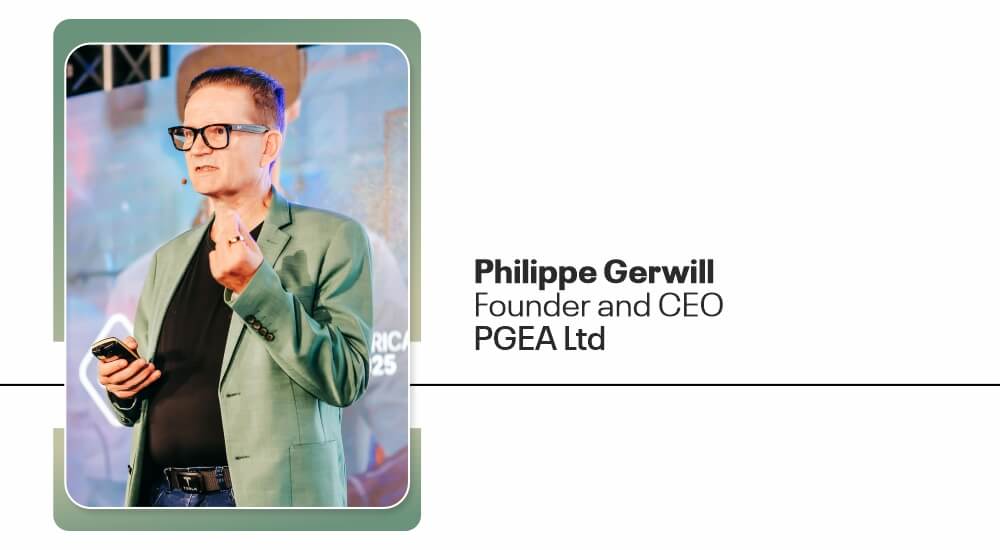
In the high-stakes theater of global healthcare, where systems are buckling under the weight of demographic shifts and economic strain, Philippe Gerwill, Founder and CEO PGEA Ltd, stands as a rare sentinel of both progress and preservation. He has spent over 30 years navigating the complex intersections of specialty chemicals, pharmaceuticals, and digital health innovation to define a new era of leadership.
For him, the journey from the rigorous laboratories of industrial management to the cutting edge of the healthcare metaverse was not a path of sudden disruption, but one of deep, observed convergence. Having held global leadership roles at titans like Novartis, Ciba, and Lonza, he has witnessed firsthand how systems fail slowly and politely until they collapse catastrophically. Today, he translates these hard-won corporate lessons into a clarion call for “controlled urgency” in a world where technology is no longer a luxury, but a survival mechanism.
The Genesis of Digitalization Humanism
The philosophy that defines Philippe’s career did not emerge from a place of blind optimism. Instead, it was forged in the reality of watching systems crack under pressure while leaders pretended everything was under control. His early years in specialty chemicals and pharmaceuticals instilled in him a profound respect for scientific rigor and the understanding that when complex systems fail, the consequences are measurable and often irreversible.
As he moved into global leadership, Philippe saw a healthcare system that was outwardly stable but internally overheating. Costs were exploding, workforce burnout was becoming systemic rather than episodic, and demographics were shifting faster than systems could adapt. “Digitalization Humanism,” Philippe explains, “is at its core, a rejection of institutional denial “.
It is a response to a present crisis where the “house is on fire,” and the time for discussing aesthetics has passed.
In this context, he views technology as the only way to compensate for the crushing shortages in the workforce and the unsustainable economics of modern care. However, he remains adamant that technology alone isn’t a hollow savior. Without human leadership and ethical clarity, digital tools will only accelerate a total system collapse. He insists on a non-negotiable principle: humans must remain in charge morally, clinically, and politically.
Lessons from the Corporate Trenches
His mindset as an advisor and futurist is deeply shaped by his time within the corridors of the world’s largest organizations. Corporate life taught him that scale can be a double-edged sword; it amplifies success, but it also amplifies denial. In large systems, it becomes increasingly difficult to admit when fundamentals are broken.
He observed a recurring pattern where warning signs were normalized and short-term performance metrics were used to delay necessary structural changes. Today, Philippe sees this same pattern repeating across the global healthcare landscape. We continue to optimize models that no longer match the reality of an aging population and a shrinking workforce.
He identifies fear rather than a lack of technology as the primary constraint on innovation. Leaders often fear regulation, disruption, and a loss of control. His role now is to help these leaders confront the uncomfortable truth: the systems they are defending are no longer sustainable, and doing nothing is no longer a neutral stance; it is a decision with dire consequences.
The Convergence of Biology, Data, and Computation
The transition he made from industrial management to futuristic domains like AI and the healthcare metaverse was driven by the merging of biology, data, computation, and connectivity. He realized that healthcare was evolving from a purely clinical system into a cognitive one, where algorithms now shape how decisions are framed and trusted.
While he is optimistic about the transformative power of earlier diagnoses and personalized therapies, he is equally wary of a subtle “human risk”. As systems become more automated, there is a danger that human professionals will become purely procedural, surrendering their critical thinking to the convenience of the algorithm.
To counter this, Philippe advocates for a “deliberate resistance to convenience”. He believes that technology should challenge us to think better, not think less. If we do not actively reinforce human judgment and empathy, we risk a future where machines appear intelligent while humans behave mechanically. Humans must remain accountable decision-makers, not merely supervisors of “black boxes”.
Advising the AI Transformation
When advising organizations on AI-driven transformation, he rejects what he calls “false choices”. He argues that technology is actually the only way to preserve humanity in healthcare today, as it is the only tool capable of freeing clinicians from the complexity that causes them to drown.
However, for him, the design of this technology must always serve human intent. He insists that humans, not vendors, algorithms, or convenience, must define the objectives and boundaries. Before any deployment, he asks organizations three non-negotiable questions:
- Who remains accountable?
- How is human judgment preserved?
- How is empathy protected under pressure?
If these answers are unclear, Philippe maintains that the system is simply not ready. AI must be used to reduce cognitive overload, not to replace the act of thinking itself. If technology turns healthcare professionals into passive executors, it has failed its purpose.
Symptoms vs. Fundamentals
Having lived and worked across multiple continents, he has gained a unique vantage point on the global healthcare ecosystem. He has found that while the symptoms of healthcare collapse vary by culture, the root causes remain universal: aging populations, workforce shortages, exploding costs, and fragmented systems.
This global experience has reinforced his belief that ignoring reality is a universal mistake. He argues that leadership in this space is not about exporting a single model to different countries, but about adapting radically while respecting local values. For Philippe, “cultural intelligence” is not just a soft skill; it is a critical component of risk management. He believes technology allows for adaptation at scale, but only if leadership listens before deploying.
The Mission of PGEA Ltd
Through his consultancy, PGEA Ltd, he champions the intersection of AI, empathy, and education. He founded the firm on the observation that healthcare organizations are not failing because they lack technology, but because they are deploying it without redefining human roles and governance.
Philippe describes his vision as “controlled urgency”. He recognizes that the system must change fast because it is “burning,” but it must change with humans firmly in charge. He views AI as a mandatory tool to compensate for administrative burdens and cost curves, but warns that AI without empathy is not transformation, it is destabilization.
Education is a cornerstone of his work because clinicians and policymakers are being asked to operate systems they were never trained for. He believes we cannot expect trust if we do not invest in understanding. Empathy is central because pressure naturally pushes systems toward dehumanization. Ultimately, he measures his impact not by the number of tools deployed, but by whether a system becomes more humane under stress.
Ethics as the Operating System of Trust
In the promising frontiers of precision medicine, digital twins, and virtual care, Philippe sees “survival mechanisms” rather than mere futuristic concepts. He acknowledges that humans alone can no longer process the staggering volume of data, protocols, and administrative requirements present in modern medicine.
However, as technology becomes more intimate, Philippe argues that the ethical responsibility grows heavier. He views data as identity, suggesting that building digital representations of people carries a moral duty equivalent to clinical care. He advocates for continuous consent, intelligible transparency, and active monitoring for bias.
Philippe strongly disagrees with the idea that ethics slows down innovation. On the contrary, he believes ethics is what prevents innovation from destroying trust at the exact moment it is most needed.
“In a healthcare system under fire,” he notes, “losing trust is fatal”.
Designing for Human Fragility
Philippe also serves as an advisor for initiatives in mental health, women’s health, and longevity. These diverse areas are connected by a common thread: they reveal the deepest cracks in the industrial healthcare model. These domains require continuity, personalization, and empathy qualities that current systems are structurally poor at delivering.
In these areas, Philippe sees people not as transactions, but as “lived stories over time”. He believes that human-centered progress means designing for fragility rather than just performance. AI can support these long-term relationships, but Philippe insists that the goal is not optimization; it is dignity. Healthcare is not a factory; it is a relationship that unfolds over decades.
Constant Principles: Integrity, Curiosity, Responsibility
Despite thirty years of navigating industrial complexity and technological evolution, Philippe’s core leadership principles have remained constant.
He believes that while frameworks and buzzwords rotate, “everything changes except responsibility”.
- Integrity: Philippe views trust as the “operating system” of healthcare. Once it is damaged, no algorithm can restore it; it requires time, consistency, and moral coherence.
- Curiosity: He believes denial is the greatest risk in times of disruption. Systems collapse when leaders stop questioning assumptions that no longer match reality.
- Responsibility: As tools become more powerful, Philippe argues that the obligation to use them wisely becomes heavier.
For Philippe, leadership today is no longer about being right in hindsight. It is about making accountable decisions early enough to prevent irreversible damage. In a system on fire, he believes neutrality is merely a form of avoidance.
The Decisive Decade
Looking ahead, Philippe sees the next decade as a crossroads. Healthcare will either become augmented and humane, or automated and alienating. He believes there is no stable middle ground.
Philippe argues that expecting clinicians to handle the current cognitive and administrative load without AI is no longer heroic; it is irresponsible. However, the real battle will be moral. If AI is used to remove friction and free time for human connection, healthcare can become more compassionate than ever. If it is used only to maximize throughput while eroding presence, it will become efficient but cruel. His goal is to elevate empathy from a “soft skill” to a core system design principle.
Mentoring “Braver Stewards”
When mentoring young innovators, Philippe begins by stripping away “comforting illusions”. He tells them plainly that they are inheriting a system in crisis, not a stable one.
He teaches his mentees to hold two truths simultaneously: technology is necessary, but humanity is non-negotiable. He warns against the extremes of techno-utopianism and technophobia, both of which destroy trust and access to care. For Philippe, mentorship is not about producing faster innovators, but about producing “braver stewards” who understand that AI amplifies responsibility rather than reducing it. Wisdom, he says, is the rarest leadership capability in a world of intelligent machines.
The Triple Helix of Survival
Philippe is a staunch advocate for collaboration between academia, industry, and policy ecosystems. He believes the “Triple Helix” is no longer a theoretical model but a survival requirement because no single actor can fix healthcare alone.
He criticizes the traditional sequential model where innovation happens first, and regulation follows. Instead, he calls for synchronized evolution where policy evolves with technology and research engages with operational reality. Innovators must accept accountability, not just valuation, because in a system on fire, misalignment is harm.
The Duty of Thought Leadership
As a thought leader, Philippe believes his duty is to stand in the gap between technical capability and human comprehension. He rejects the idea that ethics can be outsourced to committees or compliance checklists. To him, ethics is a practice that lives in daily decisions, trade-offs, and incentives.
He emphasizes the need for the courage to be uncomfortable. This means challenging speed-driven narratives and exposing the blind spots that organizations often prefer to ignore. Philippe maintains that silence in the face of ethical shortcuts is not neutrality; it is complicity. Thought leaders must model consistency even when it is commercially unattractive or politically uncomfortable.
A Legacy of Protected Meaning
As he reflects on his journey through the Fourth Industrial Revolution, he no longer measures legacy by visibility, but by decisions that outlast him. His ambition has shifted from building systems to protecting the meaning within them.
He views the current technological shift as a moral stress test. The defining question of our time, according to Philippe, is not what machines will be able to do, but whether humans will still choose to lead. He wants to leave behind the conviction that technology did not destroy healthcare avoidance, delay, fear, and lack of responsibility did.
The Paradox of Responsible Speed
He is openly critical of the “move fast” mindset when applied blindly to healthcare. He is openly critical of the “move fast” mindset when it is applied blindly to healthcare. While he acknowledges that speed is essential given the immense strain on the system, he cautions that it becomes dangerous when speed is mistaken for genuine progress.
In healthcare, mistakes result in harm and loss of life, not just bad user experiences. Philippe calls for “clarity before velocity”. He believes leaders must hold an uncomfortable paradox: they must move faster than ever to prevent collapse, while simultaneously slowing down enough to protect human judgment and dignity. Speed without governance accelerates failure.
Amplifying Human Responsibility
He argues that AI does not absorb responsibility; it amplifies it. The more power we delegate to machines, the heavier the ethical burden on those who design and deploy them. Leaders who believe algorithms shield them from accountability are actually multiplying their risk.
Leadership in AI-driven organizations must evolve from control to stewardship. Governance must be anticipatory, and accountability must be explicit. Ethical maturity must scale faster than technical capability. Otherwise, organizations will operate systems they no longer fully understand or ethically justify.
From Operator to Steward
His own definition of leadership has evolved from delivering operational excellence to practicing stewardship. He realized that operational excellence without ethical grounding can be efficient yet harmful. Stewardship, to Philippe, means accepting responsibility not only for what works, but for what might fail and who might be affected.
Ultimately, his work is a testament to the belief that the future of healthcare will not be decided by algorithms alone. It will be decided by our collective courage to remain human in the face of exponential change. His legacy is one of care for people, for institutions, and for the long-term integrity of the healthcare systems that sustain us all. As technology evolves exponentially, Philippe reminds us that human wisdom does not; it must be actively reinforced.