
Dr. Mireille Elhajj: From Space to Solutions
Women in Leadership: Breaking Barriers and Shaping the Future in 2025
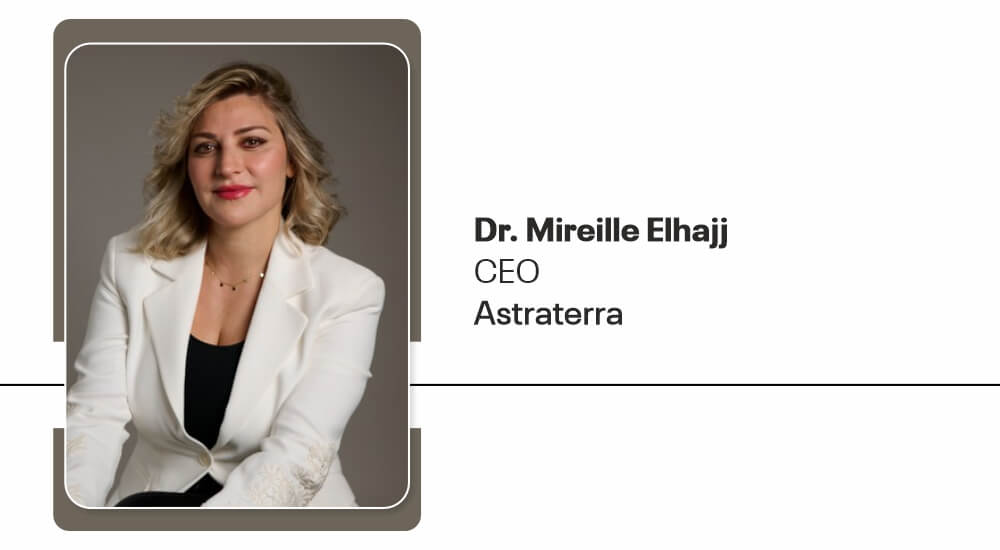
At a time when technology is reshaping economies and redefining how societies function, strong leadership is needed to guide innovation into meaningful growth. Few embody this blend of vision and execution as powerfully as Dr. Mireille Elhajj.
As CEO of Astraterra, she has built a reputation for turning complex science into real-world solutions, and now her influence extends even further with her appointment as Chair of the Scale-Up Council at TechUK. The Council plays a vital role in supporting high-potential technology companies on the cusp of rapid expansion, and Dr. Elhajj’s leadership signals a commitment to nurturing innovation, strengthening the technology ecosystem, and driving sustainable economic growth in the UK and beyond.
A Childhood Shaped by Broken Systems
Growing up in Lebanon, Mireille witnessed first-hand what happens when infrastructure falters under the weight of wars and mismanagement. Roads, transport, and essential services often lay in disrepair, and those early images stayed with her. Instead of turning away, she leaned in with curiosity, determined to understand the mechanics behind these vital systems. That curiosity set her on the path to Transportation Engineering, a discipline that gave her the scientific foundation and strategic tools to address systemic challenges.
Her professional journey took on a new dimension when she was introduced to telematics and sensor fusion in transportation. The connection between satellites in the sky and how machines respond on the ground fascinated her deeply. So much so that when she launched her company, she named it Astraterra; a nod to the link between the stars and the earth.
With earlier academic roots in business and financial management, along with experience in banking and private equity, Mireille blended scientific rigor with business acumen. This combination became her trademark: applying science and strategy with a practical edge. Today, at Astraterra, she channels that same drive into mentoring start-ups and collaborating with innovators who share her passion for building solutions that matter.
Balancing Data with Instinct
Mireille often describes her dual identity as scientist and entrepreneur as less of a balancing act and more of a partnership between logic and intuition. On one hand, her scientific training taught her to break down problems with precision, to rely on evidence, and to build solutions that are robust and reliable. On the other, entrepreneurship demands agility, foresight, and an instinctive feel for opportunities that numbers alone cannot capture.
For her, intuition is not a gamble but a finely tuned sense that grows from experience. It helps her anticipate needs, adapt to shifting environments, and connect with people on a human level. She believes business is never just about numbers, it thrives on relationships, timing, and a willingness to act decisively. At Astraterra, this blend of analysis and instinct is what keeps strategies practical, relevant, and designed for the long haul.
A Different Kind of Consultancy
The idea behind Astraterra was born from Mireille’s desire to create something of her own. After years of working in academia and traditional consultancy, she envisioned a company that was agile, collaborative, and unafraid to push beyond reports into real-world impact. Astraterra was designed as a space where science and technology could be translated into meaningful strategies for clients, from start-ups to governments.
What makes Astraterra distinct is its adaptability. Instead of a fixed model, the company listens closely to its clients and crafts solutions that are both analytical and creative. Its teams span the globe, bringing expertise and diversity that enrich every project. The company also partners with leading universities like Imperial College and collaborates with think-tanks such as the Royal Institute of Navigation, weaving capacity-building and critical thinking into its work.
To Mireille, Astraterra is more than a business; it’s a reflection of her belief in resilience, impact, and trust. It is a place where innovation meets responsibility, and where knowledge is always translated into action.
Leadership Across Borders
Working with international teams has given Mireille a global lens on leadership. Astraterra’s network stretches across the UK, Europe, the US, Latin America, the Middle East, India, and China. Each culture brings its own perspective, and Mireille has learned that real leadership is as much about listening as it is about guiding.
Her style is rooted in openness. She values vulnerability in her teams, encouraging people to share not just strengths but also weaknesses. That honesty builds trust, strengthens collaboration, and sparks creativity. In her view, innovation is never a solo act, it flourishes when diverse voices come together with respect and curiosity.
The Invisible Backbone of Modern Life
Mireille often describes Positioning, Navigation, and Timing (PNT) as the invisible scaffolding of the modern world. While most people never think about it, PNT is embedded in nearly everything we do, whether it’s air travel, maritime shipping, logistics, daily deliveries, or even the smooth running of financial systems. Without reliable PNT, modern infrastructure would grind to a halt.
She points out that as society moves deeper into automation and hyper-connectivity, the importance of accurate and resilient positioning and timing only grows. Autonomous transport, drone deliveries, emergency response, and self-driving cars all depend on these systems functioning without interruption. Even a minor disruption can ripple across supply chains, energy grids, and economies.
Her fascination with PNT lies in its ability to merge scientific innovation with real-world impact. From advances in AI models and integrity monitoring to building systems that are resilient against interference, the field touches not only technology but also economics, policy, and global security. For Mireille, championing PNT is about safeguarding the backbone of modern life while opening doors to safer, smarter, and more connected societies.
Keeping Innovation Human-Centered
Technology excites Mireille, but she is quick to remind that it must never become innovation for innovation’s sake. Her guiding question has always been: what human need are we trying to solve?
This principle is at the core of Astraterra’s work in smart cities and infrastructure. When designing navigation systems, the company doesn’t just focus on technical accuracy; it prioritizes accessibility, inclusivity, and ethical use. A clear example is Astraterra’s project with Transport for London and Imperial College London, where her team helped design GNSS antennae for the next generation of i-BUS. By studying data from 14 cities and assessing the impact of urban errors, they built a system that not only improved technical performance but also made bus travel safer and more reliable for everyday passengers.
Inclusivity has also been central to her work with Innovate UK, WeWalk Limited, and the Royal National Institute for the Blind. Together, they created a navigation and wayfinding system for the visually impaired, enhancing the basic white cane with integrated GNSS sensors, Computer Vision algorithms and safety features. The project later expanded to address mobility challenges for the ageing population, introducing wearable tools and advanced algorithms powered by computer vision and SLAM.
These projects capture Mireille’s philosophy: technology should connect, empower, and protect people. Whether it’s helping someone with disabilities navigate a city or giving elderly populations greater independence, innovation is only meaningful when it improves lives.
The Bridge Between Academia and Entrepreneurship
Mireille’s career has always straddled two worlds, entrepreneurship and academia, and she insists they make each other stronger. Her role as Visiting Professor and member of Imperial College London Industrial Board keeps her connected to cutting-edge research, interdisciplinary thinking, and the next generation of talent. She is also a member of the Scale-Up council in TechUK, a platform serving as an interface between start-ups, scales-up and governmental institutions. This role helps Astraterra’s and other companies voice to be heard and converted into next step actions.
This academic engagement enriches Astraterra’s projects. It ensures that her team isn’t simply reacting to industry trends but actively shaping them with insights drawn from the latest research. Academia fosters continuous learning, and that mindset drives her to anticipate global challenges and adapt to emerging technologies.
Her company also works closely with universities on education and capacity-building initiatives, sharing practical applications of complex technologies with students, professionals, and policymakers. For Mireille, this isn’t just about keeping Astraterra at the forefront of innovation; it’s about nurturing human capacity to meet the challenges of the future.
Inspiring the Next Generation Through Outreach
For Mireille, conferences and outreach programs are much more than events on a calendar. She sees them as catalysts, spaces where knowledge becomes collaboration and young minds discover new possibilities. Through Astraterra, she has co-developed youth training initiatives with Thunderbird School of Management in Arizona and Imperial College London, as well as specialized programs for the Saudi Space Commission that span space science and policy.
These efforts are about more than technical skill. They open the door for students and professionals to engage with complex fields like PNT and space technology in an accessible way. From Moon Day, which marked the 50th anniversary of the lunar landing, to Astraterra’s collaborations at the Farnborough Space Show as a speaker, her outreach has consistently focused on raising awareness about the role of space and data in shaping humanity’s future.
Whether it’s webinars, workshops, or global training programs, Mireille views these platforms as opportunities to ignite passion, demystify science, and connect future innovators with the experts who can mentor them. The ultimate aim is not only to build a skilled workforce but to inspire a generation driven by curiosity, collaboration, and a vision for progress.
The Future of Navigation
As a Fellow of the Royal Institute of Navigation, Mireille is particularly excited about the breakthroughs that will redefine navigation in the coming decade. The rise of Low Earth Orbit (LEO) satellite constellations promises low-latency, highly accurate positioning, even in dense urban landscapes, a great breakthrough for emergencies in remote areas, When paired with quantum PNT technologies, which offer unmatched precision and resilience against threats like jamming or spoofing, the foundation of navigation could shift dramatically.
Equally transformative is the convergence of navigation with remote sensing and next-generation communications such as 5G and 6G on novel platforms such as low earth orbit constellations and aerial platforms. This fusion enables real-time data collection, seamless connectivity, and advanced geolocation services critical for smart cities, autonomous vehicles, and drone traffic management. New research areas, such as Integrated Sensing and Communication (ISAC), are pushing boundaries even further by combining sensing and communication functions in a single platform.
For Mireille, these advancements are not just technical milestones. They represent a new era where navigation is resilient, adaptable, and deeply integrated into the systems that power society. From predicting natural disasters to managing the complexities of urban mobility, she sees navigation evolving into one of the defining pillars of global infrastructure.
Building a Better-Connected World
Looking at the horizon of intelligent solutions, Mireille envisions a world where AI, IoT, advanced satellites, and next-generation communication networks converge seamlessly. In her view, the real power of these technologies lies not in automation alone but in their ability to enhance human capabilities and solve pressing global challenges.
She points to digital twins as a game-changing tool, virtual models of physical environments that allow real-time monitoring and optimization of infrastructure. Combined with high-speed 5G and 6G connectivity, they will enable cities, transport networks, and energy systems to become more responsive and resilient.
Yet, she is clear-eyed about the responsibility that comes with innovation. Intelligent solutions, she believes, must remain human-centered, guided by ethics, and grounded in peaceful application. Whether tackling climate change, improving healthcare, or managing resources more sustainably, these technologies should empower people and foster stability rather than widen divides. To her, the future of connectivity is meaningful only when it helps create a more sustainable, inclusive, and peaceful global society.
The Legacy of Astraterra
When Mireille reflects on the future of Astraterra, she sees a legacy that goes beyond projects and contracts. Her vision is twofold: to be remembered as a pioneer that bridged science, engineering, and strategy to tackle the world’s most complex challenges, and to inspire a new generation of scientists, engineers, and entrepreneurs to use their talents for the greater good.
Astraterra’s contributions to PNT, space applications, and resilient infrastructure are part of that story. But just as important is the company’s culture of mentorship and collaboration, which Mireille hopes will ripple far into the future. Her ultimate goal is to have created not only a firm that delivered innovation but one that built trust, nurtured talent, and left the world more connected, secure, and resilient than before.